HEPA Filter vs Nano Filter: Which Is Better for an Air Purifier?
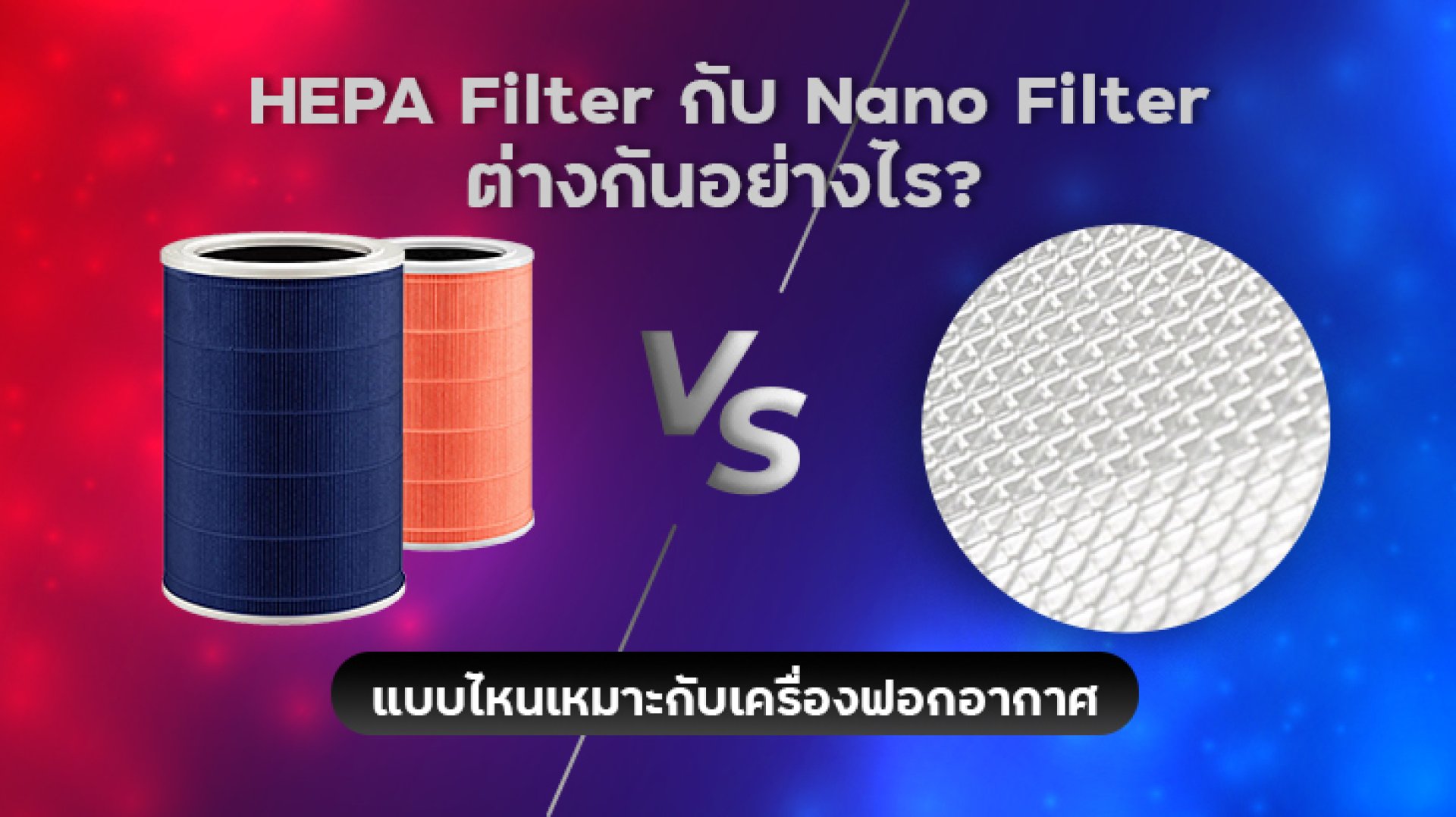
When choosing an air purifier, you may come across terms such as HEPA Filter, Nano Filter, nanofiber filter, or high-efficiency filter. But are these technologies actually the same? And is a Nano Filter better than a HEPA Filter?
The short answer is: not necessarily. HEPA is a defined type of high-efficiency mechanical filter, while "Nano Filter" can refer to different filter technologies or nanofiber materials depending on the manufacturer.
Therefore, when comparing an air purifier, you should not judge the filter only by its name. Filter efficiency, airflow, CADR, room size, pressure drop, filter construction, and replacement cost are all important factors.
What Is a HEPA Filter?
HEPA stands for High Efficiency Particulate Air. It is a type of pleated mechanical air filter commonly used in portable air cleaners and air purifiers.
According to the U.S. Environmental Protection Agency (EPA), a HEPA filter can theoretically remove at least 99.97% of particles at 0.3 microns (µm) under the relevant test condition. The 0.3-micron particle size represents the most penetrating particle size (MPPS), or a particularly challenging particle size for the filter. Particles larger or smaller than this can also be captured with high efficiency.
HEPA filters work through mechanical particle filtration. Depending on particle size and airflow conditions, particles can be captured through mechanisms such as interception, impaction, diffusion, and related filtration effects.
What Can a HEPA Filter Capture?
- Fine particulate matter
- PM2.5 particles
- Dust
- Pollen
- Mold particles
- Many airborne biological particles
However, a HEPA filter is primarily a particle filter. It should not be considered the main solution for removing gases, VOCs, or odors.
For gases and odors, an air purifier generally needs another filtration stage such as activated carbon. EPA guidance also distinguishes particle filtration from gas filtration and recommends activated carbon or another gas-removal technology when gas removal is required.
What Is a Nano Filter?
Nano Filter is a more complicated term because it does not describe one universally standardized filter class in the same way that HEPA describes a specific high-efficiency filter type.
Depending on the manufacturer, "Nano Filter" may refer to nanofiber filter media, very fine fibers, specially engineered filter layers, or a proprietary filtration technology.
Nanofiber-based filter media can be engineered to provide a large surface area for particle capture while maintaining relatively low airflow resistance. However, the actual performance depends on the fiber material, structure, density, thickness, pleating, airflow, and testing method.
Therefore, the word Nano by itself does not prove that a filter is more efficient than HEPA.
HEPA Filter vs Nano Filter: What Is the Difference?
| Feature | HEPA Filter | Nano Filter |
|---|---|---|
| Definition | Defined type of high-efficiency mechanical filter | Can refer to different technologies or nanofiber media |
| Particle filtration | Very high efficiency when properly designed and tested | Depends on the specific filter construction |
| PM2.5 filtration | Suitable for fine particle filtration | Can be suitable depending on the product specification |
| Standardization | More clearly defined | Term can vary between manufacturers |
| Gas and odor removal | Not the primary function | Not the primary function unless combined with another technology |
| What to check | Efficiency, test standard, CADR and system design | Efficiency data, test method, pressure drop and CADR |
Can Both HEPA and Nano Filters Remove PM2.5?
Yes, both can potentially remove PM2.5. However, the important point is not simply whether a filter is called HEPA or Nano.
You should look at the actual filtration performance of the product, the airflow through the filter, and the overall air purifier system.
An air purifier with an excellent filter but insufficient airflow may clean a room more slowly than a well-designed system with a suitable filter and higher CADR.
EPA guidance recommends considering the air purifier's Clean Air Delivery Rate (CADR) and choosing a unit appropriately sized for the room. Higher CADR generally means that more filtered air is delivered in a given amount of time.
Is a Nano Filter Better Than a HEPA Filter?
Not automatically.
This is one of the most important points when comparing air purifier filters.
A filter labeled "Nano" is not automatically more efficient simply because the fibers are extremely fine. Likewise, a HEPA filter is not automatically the best choice in every application without considering airflow and the overall system.
A better comparison should look at:
- Particle filtration efficiency
- Test method and test conditions
- Pressure drop
- Airflow
- CADR
- Filter surface area
- Filter thickness and construction
- Filter replacement interval
- Replacement filter cost
In other words, filter technology is only one part of an air purifier's performance.
Why Does CADR Matter When Choosing an Air Purifier?
Imagine two air purifiers:
- Model A has a very high-efficiency filter but low airflow.
- Model B has a high-efficiency filter and significantly higher airflow.
Even if both filters perform well in laboratory testing, Model B may be able to deliver more cleaned air through the room in the same period of time.
This is why CADR is an important specification when selecting a portable air purifier.
EPA explains that CADR represents the delivery of filtered air and can help consumers compare how quickly an air cleaner can remove particles from a room.
You should therefore avoid choosing an air purifier based only on the words "HEPA" or "Nano."
Which Should You Choose: HEPA or Nano Filter?
Choose a HEPA Filter If You Want:
- A clearly defined high-efficiency particle filter
- Strong filtration of fine particles
- A filter specification that is easier to evaluate
- An established technology commonly used in air purifiers
- A straightforward option for PM2.5 filtration
HEPA is particularly attractive if you want a filtration technology with a clearly defined performance characteristic rather than relying on a marketing term.
Consider a Nano Filter If:
- The manufacturer provides reliable filtration test data
- The filter has good airflow characteristics
- The filter has a suitable pressure drop
- The purifier provides a strong CADR for its intended room size
- Replacement filters are readily available
In this case, the key is to evaluate the actual specifications rather than the word "Nano."
How to Choose an Air Purifier for PM2.5
If your primary goal is reducing PM2.5, consider these factors in this order:
- Check the filtration technology. Look for a clearly specified high-efficiency particle filter.
- Check the CADR. Make sure the purifier is suitable for the size of the room.
- Check airflow. A filter needs sufficient airflow through the system to deliver meaningful room cleaning.
- Check the replacement filter. Make sure replacement filters are available and reasonably priced.
- Check the whole system. Air leakage, filter sealing, fan performance and the purifier's overall design also affect real-world performance.
EPA recommends selecting a portable air cleaner that is appropriate for the room size and considering CADR when evaluating particle removal performance.
Can HEPA and Nano Filters Be Used Together?
Yes. An air purifier can use multiple filtration stages.
A typical multi-stage system may include:
- Pre-filter
- HEPA or high-efficiency particle filter
- Activated carbon filter
- Additional specialized filtration technology
The purpose of each stage can be different. The pre-filter can capture larger particles, the particle filter targets fine particles, and activated carbon is used for certain gases and odors.
Using multiple stages does not automatically mean better performance. The system still needs suitable airflow, proper sealing, and a fan capable of moving air through the filters.
Which Filter Is Better for Odors?
If odor removal is your main goal, neither HEPA nor a typical particle-focused Nano Filter should be your only consideration.
Activated carbon is commonly used for gases and odors because it can adsorb certain gaseous pollutants.
EPA specifically recommends activated carbon or another filter designed for gases when gas removal is required.
Therefore, if you want an air purifier that handles both PM2.5 and odors, a combination such as:
Pre-filter + high-efficiency particle filter + activated carbon
can make more sense than choosing between HEPA and Nano based on the filter name alone.
How to Avoid Confusion When Buying a Nano Filter Air Purifier
If a product advertises a "Nano Filter," check whether the manufacturer provides measurable performance information.
Look for:
- Particle filtration efficiency
- Particle size used in testing
- Testing standard or laboratory method
- CADR
- Pressure drop or airflow information
- Recommended room size
- Replacement filter availability
Be careful with claims such as "Nano is better than HEPA" when there is no supporting test data.
The name of a technology is not enough to determine real-world filtration performance.
HEPA Filter vs Nano Filter: Which One Should You Choose?
If you want a simple answer, HEPA is generally the easier technology to evaluate because the term refers to a defined type of high-efficiency mechanical filter.
A Nano Filter can also be an excellent filtration technology, but you should evaluate the specific product's performance data rather than assuming that "Nano" automatically means better.
For most people choosing an air purifier for PM2.5, the best approach is to consider the complete system:
- Particle filtration efficiency
- CADR
- Room size
- Airflow
- Filter surface area
- Filter replacement cost
- Activated carbon for odors and gases
In other words: Don't choose the filter name. Choose the performance.
Related Articles
Frequently Asked Questions
Is a Nano Filter better than a HEPA Filter?
Not necessarily. "Nano Filter" can refer to different technologies, while HEPA is a defined type of high-efficiency mechanical filter. Compare actual filtration efficiency, test data, CADR, airflow, and pressure drop instead of relying only on the filter name.
Can a Nano Filter remove PM2.5?
It can, depending on the filter's construction and tested particle filtration performance. Check the manufacturer's specifications and test results.
Can a HEPA Filter remove PM2.5?
Yes. HEPA filters are designed for high-efficiency particle filtration and can capture fine airborne particles, including PM2.5, when used in a properly designed air-cleaning system. EPA states that HEPA filters can theoretically remove at least 99.97% of particles at 0.3 microns under the relevant test condition.
Does HEPA remove odors?
HEPA is primarily a particle filter and is not designed to be the main gas or odor-removal stage. Activated carbon is commonly used for gases and odors.
What should I check when buying a Nano Filter air purifier?
Check filtration efficiency, testing method, CADR, airflow, pressure drop, room-size rating, and replacement filter availability.
Is CADR more important than the filter type?
Both matter. A high-efficiency filter is important, but CADR indicates how much cleaned air the system can deliver. Therefore, evaluating the complete air purifier system is more useful than looking at filter technology alone.
Conclusion
HEPA Filter vs Nano Filter is not simply a matter of choosing which name sounds more advanced.
HEPA is a clearly defined high-efficiency mechanical filtration technology, while Nano Filter can describe different types of nanofiber or proprietary filtration technologies.
If you want a straightforward choice for fine particle filtration, HEPA is easier to evaluate because its performance characteristics are more clearly defined.
However, a well-designed Nano Filter can also perform very well. The key is to look beyond the marketing name and evaluate filtration efficiency, CADR, airflow, room size, pressure drop, and replacement cost.
For an air purifier intended to handle both PM2.5 and odors, consider a multi-stage system that combines a high-efficiency particle filter with activated carbon.
Ultimately, the best air purifier is not necessarily the one with the most impressive filter name. It is the one that delivers the right combination of filtration performance and clean-air delivery for your room.
References
- U.S. Environmental Protection Agency (EPA). What is a HEPA Filter?
- U.S. Environmental Protection Agency (EPA). Guide to Air Cleaners in the Home.
- U.S. Environmental Protection Agency (EPA). What is a MERV Rating?
- U.S. Environmental Protection Agency (EPA). Air Cleaners and Air Filters in the Home.
- U.S. Environmental Protection Agency (EPA). Indoor Air Filtration.