What Is CADR? How Much CADR Does an Air Purifier Need?
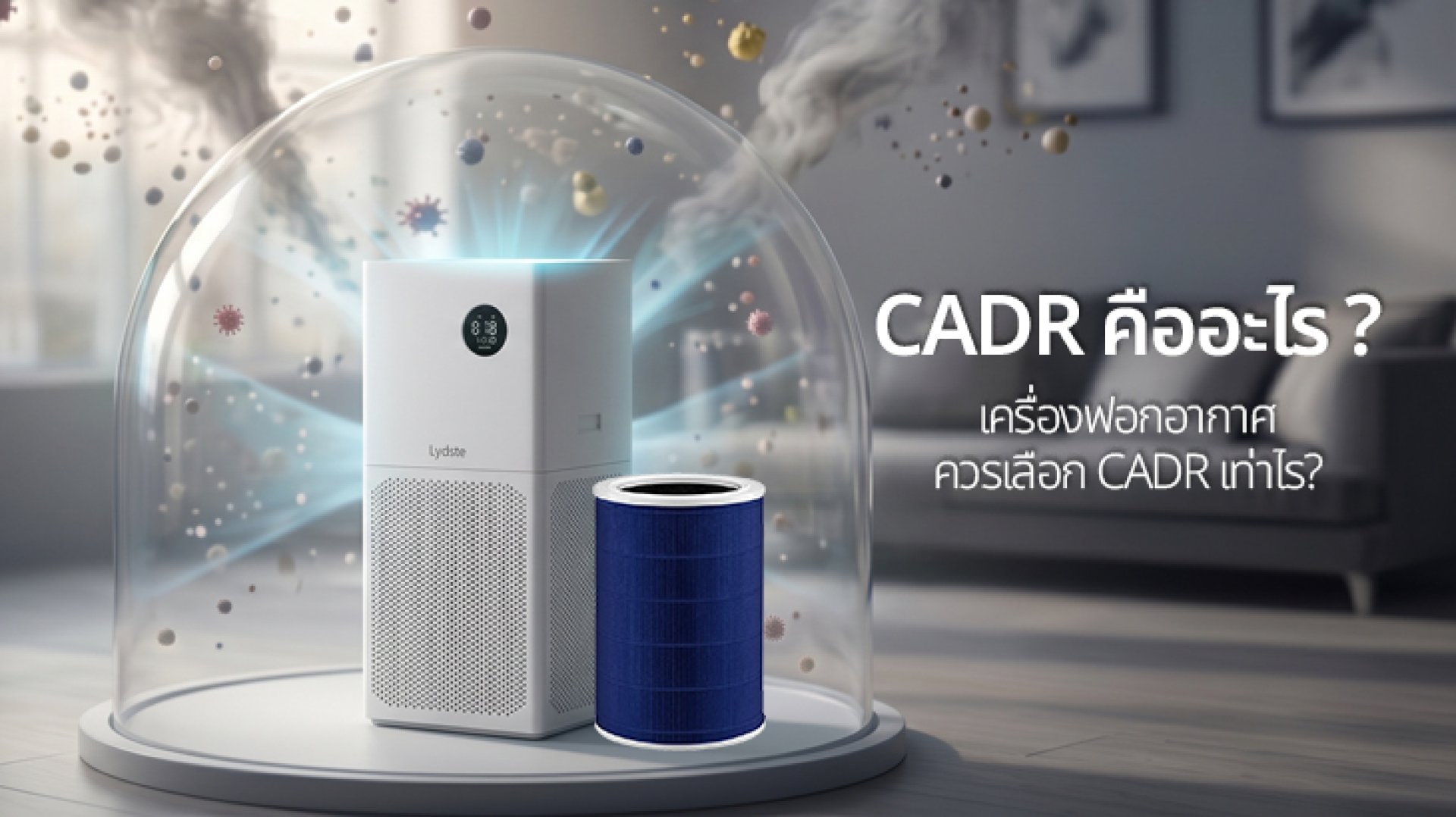
When shopping for an air purifier, you may come across numbers such as CADR 200, CADR 300, or CADR 500. But what do these numbers actually mean? And if your bedroom is 20 square meters, how much CADR do you really need?
CADR is one of the most useful specifications for choosing an air purifier because it indicates how quickly a purifier can deliver filtered air into a room. It can help you determine whether a particular air purifier is appropriately sized for your space.
In this guide, we'll explain what CADR means, whether higher CADR is better, how much CADR you need for different room sizes, and how CADR differs from a HEPA filter.
What Is CADR?
CADR stands for Clean Air Delivery Rate. It measures the volume of filtered air that an air purifier can deliver over a specific period of time.
In simple terms, a higher CADR generally means that an air purifier can deliver more filtered air in the same amount of time, making it suitable for larger rooms when other factors are similar.
The U.S. Environmental Protection Agency (EPA) explains that CADR measures the amount of filtered air delivered by an air cleaner. A higher CADR means the unit can filter more particles and serve a larger area.
What Does CADR Measure?
CADR can be reported separately for different types of particles. Common ratings include Smoke, Dust, and Pollen.
| CADR Rating | Particle Type | What It Helps You Evaluate |
|---|---|---|
| Smoke CADR | Small particles | Fine particles such as those represented by tobacco smoke |
| Dust CADR | Medium-sized particles | General dust removal |
| Pollen CADR | Larger particles | Pollen and similar larger particles |
AHAM explains that CADR ratings indicate how quickly an air purifier filters these three particle categories. The higher the rating for a particular pollutant, the faster the unit can filter that type of particle.
If your main concern is PM2.5 and other fine particles, pay particular attention to the Smoke CADR when this rating is available. EPA uses tobacco smoke as a representation of smaller particles when explaining how consumers can select an air purifier for fine-particle removal.
Is a Higher CADR Always Better?
Not necessarily.
A higher CADR generally means that an air purifier can deliver more filtered air per unit of time, but CADR should not be considered in isolation.
When choosing an air purifier, you should also consider:
- Room size
- Filter type and filtration system
- Smoke, Dust, and Pollen CADR ratings
- Noise level
- Power consumption
- Replacement filter cost
- Fan speeds and operating modes
- Air quality sensors and automatic modes
EPA notes that fan speed and operating time also affect how much air is filtered. A purifier running at a lower fan speed will generally filter less air than the same unit running at a higher speed.
How Much CADR Does an Air Purifier Need?
The most important starting point is to match the CADR to the size of the room.
AHAM commonly recommends the two-thirds rule: choose an air purifier with a Smoke CADR that is at least two-thirds of the room's area when the room size is expressed in square feet.
For example, a 200-square-foot room would call for a Smoke CADR of at least about 132 CFM under this rule.
CADR Guide by Room Size
| Room Size | Approx. Area | Approx. Minimum Smoke CADR* |
|---|---|---|
| 10 m² | 108 sq ft | About 70 CFM |
| 15 m² | 161 sq ft | About 105 CFM |
| 20 m² | 215 sq ft | About 145 CFM |
| 25 m² | 269 sq ft | About 180 CFM |
| 30 m² | 323 sq ft | About 215 CFM |
| 40 m² | 431 sq ft | About 290 CFM |
| 50 m² | 538 sq ft | About 360 CFM |
*These figures are approximate calculations based on the AHAM two-thirds guideline and are intended as a general reference, not as a certification for a specific air purifier model.
EPA provides a similar sizing guide. For example, it estimates a minimum CADR of 65 CFM for a 100-square-foot room, 130 CFM for 200 square feet, 195 CFM for 300 square feet, and 390 CFM for 600 square feet. These estimates assume an 8-foot ceiling.
How Much CADR Does a 20 m² Room Need?
Let's use the two-thirds rule as a simple example.
A 20 m² room is approximately 215 square feet.
215 × 2/3 143 CFM
Therefore, an air purifier with a Smoke CADR of around 145 CFM or higher can be used as a starting point when comparing models for a 20 m² room.
However, always check the manufacturer's recommended room size and the actual CADR rating of the model you are considering. Different manufacturers may use different specifications or rating methods.
CADR and Room Size: Why Do They Matter?
Imagine two air purifiers being used in the same 20 m² room.
| Air Purifier | CADR | General Result |
|---|---|---|
| Model A | 100 CFM | May clean the room more slowly |
| Model B | 200 CFM | Can deliver more filtered air per unit of time |
This does not mean that Model B will remove exactly twice as many pollutants in every situation. However, when other conditions are similar, the higher CADR means the purifier can deliver more filtered air over the same period.
EPA's guidance similarly notes that higher CADR allows an air cleaner to filter more particles and serve a larger area.
Should You Use One High-CADR Air Purifier or Multiple Units?
For a large or open-plan space, using one large air purifier is not the only option.
EPA notes that if an area is larger than what one available air purifier can effectively serve, consumers can consider using multiple air cleaners.
For example, if your living room and dining area form one large open space, consider the total area the purifier needs to serve rather than calculating only the area immediately around the purifier.
Does Ceiling Height Affect the CADR You Need?
Yes.
Two rooms can have the same floor area but different amounts of air if their ceiling heights are different.
Many standard room-size estimates assume an approximately 8-foot ceiling. EPA specifically notes that rooms with ceilings higher than 8 feet may require an air purifier with a higher CADR or a rating for a larger room.
This is particularly important in rooms with unusually high ceilings or large open-plan areas.
CADR vs HEPA Filter: What's the Difference?
| Feature | CADR | HEPA Filter |
|---|---|---|
| What is it? | A rating for the delivery of filtered air | A type of high-efficiency particle filter |
| What does it tell you? | How much filtered air the purifier can deliver | The filter's particle filtration capability according to its applicable standard |
| What is it useful for? | Matching purifier capacity to room size | Understanding the type of particle filtration used |
| Are they related? | An air purifier can use a HEPA filter and have a high or low CADR depending on the overall system design. | |
In other words, HEPA does not automatically mean high CADR, and a high CADR does not automatically mean that an air purifier uses a HEPA filter.
EPA notes that many portable air cleaners achieve high CADR by using high-efficiency particulate air (HEPA) filters, but CADR and filter type describe different aspects of the system.
Does a High CADR Matter If the Filter Is Not Good?
CADR should not be interpreted as simply fan power. It reflects the amount of clean air delivered by the purifier and therefore incorporates both airflow and particle removal performance.
For this reason, it is better to compare the actual CADR rating of an air purifier rather than looking only at motor power or airflow specifications.
EPA's technical documentation explains that CADR is related to both the airflow rate through the unit and its particle-removal efficiency.
Can CADR Tell You How Well an Air Purifier Removes Odors?
Not directly.
Standard CADR ratings are designed around particle removal. They are not a general performance rating for gases or VOCs.
If your main concern is PM2.5 and fine particles, focus on particle-related CADR, particularly Smoke CADR when available.
If your main concern is odors, gases, or VOCs, look for an air purifier with an activated carbon filter or another filter specifically designed for gases.
EPA specifically states that the CADR rating system is for particles, while activated carbon or other gas-removal filters should be considered for gases and odors.
Can You Have Too Much CADR?
Choosing an air purifier with a higher CADR than the minimum required is not necessarily a problem. A higher CADR can allow the purifier to clean the air more quickly when operated at an appropriate fan speed.
However, a larger purifier may cost more, take up more space, and may produce more noise or use more electricity when operating at higher fan speeds.
AHAM notes that selecting a unit that is too large for a room can result in unnecessary energy use and noise, while a unit that is too small may not adequately clean the space.
The key is to balance CADR, room size, noise, energy consumption, and everyday usability.
How to Choose an Air Purifier Using CADR
- Measure the room by multiplying its length by its width.
- Check the manufacturer's recommended room size.
- Look at the CADR rating, especially Smoke CADR if fine particles such as PM2.5 are your main concern.
- Compare CADR with room size rather than choosing based only on the largest number.
- Check the filter system to make sure it matches your air-quality concerns.
- Check noise levels if you plan to use the purifier while sleeping.
- Check replacement filter costs because filters are an ongoing maintenance expense.
What Is CADR? Final Summary
CADR, or Clean Air Delivery Rate, is a measurement of how much filtered air an air purifier can deliver over time. In general, a higher CADR means the purifier can deliver more filtered air and is suitable for a larger area when other factors are comparable.
When choosing an air purifier, start with the size of the room rather than simply choosing the model with the highest CADR.
The AHAM two-thirds guideline suggests choosing a Smoke CADR of at least approximately two-thirds of the room's area in square feet. For example, a 20 m² room is approximately 215 square feet, resulting in a target Smoke CADR of roughly 145 CFM.
However, room size is not the only consideration. Ceiling height, fan speed, operating time, filter type, noise, energy consumption, and replacement filter costs can all affect the real-world experience.
And if your main concern is odors or VOCs rather than particles, remember that CADR is primarily a particle-removal rating. In that case, look for an air purifier with an appropriate activated carbon filter as well.
Frequently Asked Questions About CADR
Is a higher CADR always better?
A higher CADR generally means that an air purifier can deliver more filtered air per unit of time. However, the best CADR depends on the room size and your intended use. A very large unit is not automatically the best choice for every room.
How much CADR does a 20 m² room need?
A 20 m² room is approximately 215 square feet. Using the AHAM two-thirds guideline, the calculation is approximately 215 × 2/3 = 143 CFM. Therefore, a Smoke CADR of around 145 CFM or higher can be used as a starting point for comparison.
Is CADR the same as airflow?
No. Airflow describes how much air moves through the system, while CADR reflects the delivery of filtered air and incorporates particle-removal performance. CADR is therefore more useful when comparing an air purifier's ability to clean particles.
Can CADR measure odor removal?
Standard CADR ratings focus on particle removal rather than gases or VOCs. If odor removal is your main goal, look for an air purifier with an activated carbon filter or another gas-removal technology.
Do high ceilings require a higher CADR?
They may. A room with a higher ceiling contains more air than a room with the same floor area and a standard ceiling height. EPA notes that standard room-size estimates often assume an 8-foot ceiling and recommends considering a higher-CADR unit for rooms with higher ceilings.
Related Articles
- What Is a HEPA Filter? How Is It Different From a Regular Filter?
- Can You Wash an Air Purifier Filter? Which Filters Can Be Cleaned?